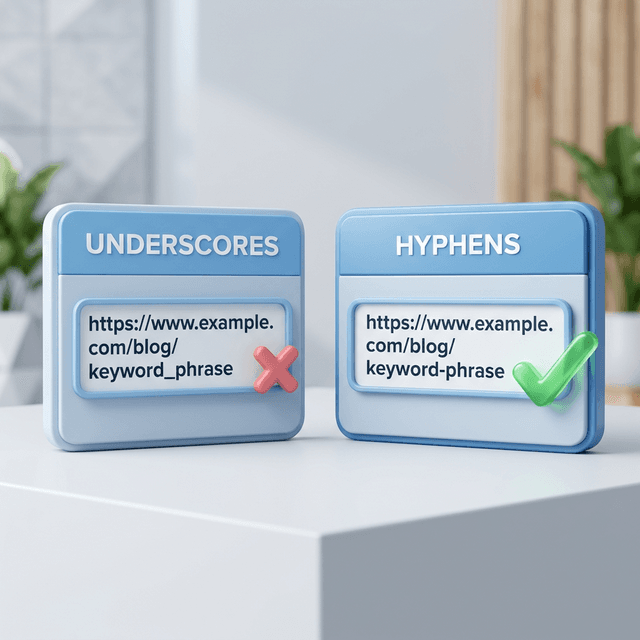

Hyphens in keywords do not usually deserve the amount of anxiety they get in SEO conversations. Most of the time, the real question is not about the keyword itself. It is about URLs, readability, and how clearly a page is structured.
That is important because teams often waste time debating punctuation while bigger issues go untouched, like weak search intent alignment, poor internal linking, or messy page architecture.
In this guide
- Whether hyphens in keywords affect rankings
- When hyphens help in URLs
- Why readability matters more than punctuation
- What to fix if your URLs are already messy
The Short Answer
Hyphens in a keyword phrase do not give you a ranking boost by themselves.
Where hyphens do matter is in URLs. Search engines and users generally read hyphen-separated words more clearly than underscored or mashed-together strings.
So the practical rule is simple:
- use normal language in your content
- use hyphens to separate words in URLs
- stop treating punctuation as a shortcut to rankings
Where People Get Confused
This topic usually gets mixed up across three separate things:
1. Keywords in the Content
If your target phrase naturally includes a hyphen because that is how people write it, use it naturally. If it does not, do not force one in.
2. Keywords in the URL
This is where hyphens help. A URL like /text-to-html-ratio is easier to read than /text_to_html_ratio or /texttohtmlratio.
3. Domain Names
Hyphens in domains are a separate decision. They are usually more of a branding and trust issue than an SEO advantage.
Why Hyphens Work Better in URLs
Search engines treat hyphens as clear word separators. That makes URLs easier to parse and easier for users to scan.
Hyphenated URLs also tend to be:
- more readable
- easier to copy and share
- easier to audit at scale
- less prone to ugly formatting choices
That fits into a broader website taxonomy and keyword mapping workflow, where page organization matters much more than punctuation debates.
What Actually Matters More Than Hyphens
Search Intent Match
If the page solves the wrong problem, punctuation will not save it.
Clear Page Targeting
A page should have one main job. If it tries to rank for five overlapping intents, the structure is already weak.
Internal Linking
Well-placed internal links reinforce relevance and discovery far more than minor URL formatting choices.
Clean Site Architecture
A readable slug is useful, but it is only one part of a page being easy to find, understand, and crawl.
For a stronger baseline, connect this with your on-page SEO checklist and internal linking SEO guide.
Common URL Mistakes
- stuffing multiple keywords into one slug
- repeating the same words from parent folders
- leaving autogenerated dates and stopwords everywhere
- using underscores instead of hyphens
- changing old URLs just to make them look cleaner without a redirect plan
That last one matters. A perfect-looking URL is not worth breaking existing equity and internal links without a reason.
When You Should Change a URL
Usually only when:
- the current slug is unreadable
- the page target has fundamentally changed
- the site structure is being cleaned up anyway
- you can implement a proper redirect
Do not change URLs just because you found a minor formatting preference in a forum thread.
A Better Rule for SEO Teams
Use this:
- Keep slugs short and readable.
- Separate words with hyphens.
- Make the page intent obvious.
- Preserve existing URLs unless there is a real reason to change them.
- Focus the rest of your effort on content quality and internal relevance.
That rule is boring, which is exactly why it works.
Ready to Automate Your SEO?
AgenticSEO helps you prioritize the page changes that actually move performance, instead of getting stuck on low-impact SEO debates.
Start your free AgenticSEO analysis workflow
Frequently Asked Questions
Do hyphens in keywords improve rankings?
Not by themselves. The bigger impact comes from relevance, page quality, internal links, and clean structure. Hyphens mainly help when they make URLs easier to read and parse.
Are underscores bad for SEO in URLs?
They are usually a weaker choice than hyphens because hyphens are the clearer standard for separating words. If you are creating new URLs, prefer hyphens.
Should I change old URLs to add hyphens?
Only if the current URL is genuinely problematic and you can redirect it properly. Changing stable URLs for cosmetic reasons often creates more risk than reward.
Key Takeaways
- Hyphens in keywords are usually not the real SEO issue.
- Hyphens are most useful in URLs because they improve readability and word separation.
- Search intent, page targeting, and internal linking matter more than punctuation.
- Do not rewrite stable URLs unless there is a clear structural reason and a redirect plan.