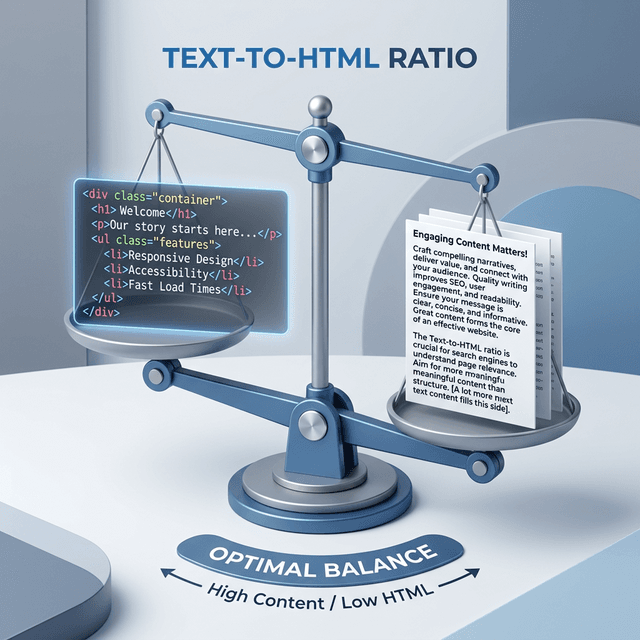

Text to HTML ratio sounds like one of those technical SEO metrics that must matter because it looks precise. In practice, it is usually overvalued.
The ratio simply compares how much visible text a page has against how much HTML code surrounds it. That can sometimes highlight bloated templates or very thin pages, but it is not a reliable ranking signal on its own.
In this guide
- What text to HTML ratio actually measures
- Why the metric is often misunderstood
- When a low ratio points to a real issue
- What to check instead if rankings are weak
What Text to HTML Ratio Is
Text to HTML ratio measures the proportion of visible text on a page compared with the total HTML code size.
A simple version of the idea is:
- more code and less text creates a lower ratio
- more text and less code creates a higher ratio
Some tools present this as a page-quality score. That framing is where the confusion starts.
Why SEO Teams Overrate This Metric
The ratio feels neat because it produces a number. But SEO is full of situations where a neat number is less useful than a better question.
A page can have:
- a low text to HTML ratio and still rank well
- a high text to HTML ratio and still perform badly
That is because search engines do not reward a ratio. They evaluate relevance, usefulness, page quality, structure, and accessibility to content in a much broader way.
When Text to HTML Ratio Can Be Helpful
The metric is still useful as a clue.
It can help surface pages that may have:
- extremely thin content
- bloated templates
- too much repetitive code
- hidden content problems
- weak rendering or layout choices
So the best way to use it is as a diagnostic hint, not as a KPI.
If a page looks weak, this number can point you toward a review. It should not decide the verdict by itself.
What Usually Matters More
Content Quality
Is the page actually useful, specific, and aligned to the query?
Search Intent
Does the page solve the problem the searcher expects solved?
Indexability
Can search engines access, crawl, and index the page cleanly?
Template Bloat
Is the page carrying too much code, repetitive markup, or unnecessary elements?
Internal Linking
Is the page connected to the rest of the site in a way that supports discovery and relevance?
That is why a better review path is often your SEO audit workflow, noindex checker, and website taxonomy guide, not a single ratio score.
What a Low Ratio Might Be Telling You
Sometimes a low text to HTML ratio does point to a real problem.
The Page Is Thin
There is simply not enough useful copy to support the topic.
The Template Is Heavy
The page may contain too much layout code, inline styling, third-party widgets, or repeated interface elements relative to the actual content.
The Main Content Is Hard to Reach
If the important copy is buried below repeated blocks, the ratio may reflect a structure problem more than a content problem.
The Page Was Built More for Design Than Clarity
Beautiful pages can still perform well, but only if the content remains clear and accessible.
What To Check Instead of Chasing a Perfect Ratio
Use this order:
- Confirm the page is indexable.
- Review whether the page satisfies search intent.
- Check for thin, duplicated, or vague content.
- Review internal links and topical relevance.
- Look for template bloat, unnecessary code, or weak rendering choices.
This gives you a much better path than trying to force every page into an arbitrary text-to-code benchmark.
A Better Way to Use the Metric
Treat text to HTML ratio like a smoke signal.
If the number is unusually low and the page also has weak performance, then investigate:
- thin body copy
- overbuilt templates
- layout clutter
- rendering issues
- repetitive boilerplate
If the page performs well, do not create busywork just because a tool says the ratio is imperfect.
Why This Matters for Agentic SEO
This is a good example of where SEO teams lose time on the wrong abstraction. A narrow technical number feels actionable, but it often distracts from the real issue.
The stronger move is to connect metrics to outcomes:
- impressions
- clicks
- rankings
- indexing health
- conversion paths
That is how you keep audits practical instead of theoretical.
Ready to Automate Your SEO?
AgenticSEO helps you turn technical signals into prioritized actions, so you spend more time fixing real blockers and less time chasing vanity diagnostics.
Start your free AgenticSEO analysis workflow
Frequently Asked Questions
Is text to HTML ratio a Google ranking factor?
There is no strong reason to treat it as a direct ranking factor. It is better used as a supporting diagnostic that may highlight content or template issues.
What is a good text to HTML ratio?
There is no universal ideal number. Different page types, templates, and layouts naturally produce different ratios. Context matters more than a benchmark.
When should I take a low ratio seriously?
Take it seriously when it appears alongside weak page performance, thin content, bloated templates, poor rendering, or difficult-to-find main content.
Key Takeaways
- Text to HTML ratio is a clue, not a standalone SEO verdict.
- A low ratio can point to thin content or heavy templates, but it does not prove either one by itself.
- Search intent, indexability, internal links, and content usefulness matter more than a ratio target.
- Use the metric to guide a review, not to drive blind fixes.