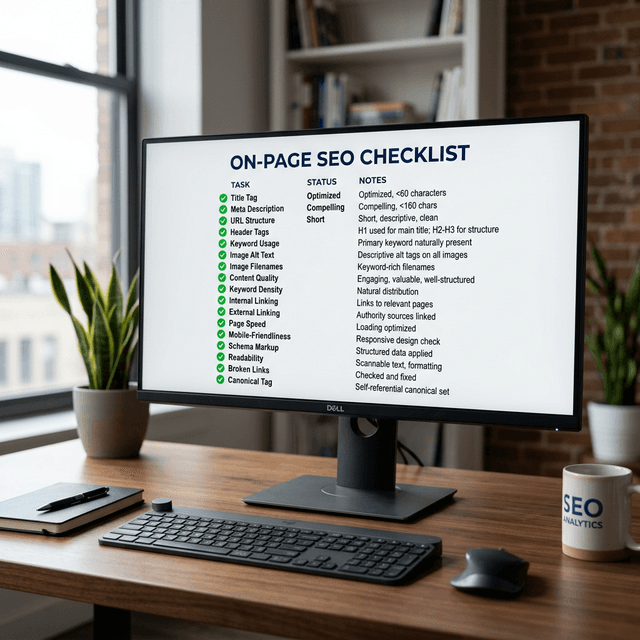

Off-page SEO — backlinks, brand signals, authority — gets most of the attention in SEO strategy conversations. It's dramatic: link acquisition is competitive, link building is expensive, and backlinks remain one of the most powerful ranking signals Google uses. But the most durable, controllable, and directly impactful SEO work happens on the page itself. On-page SEO is every signal you send through the content, structure, metadata, and technical implementation of an individual URL — and it's the foundation that determines whether any off-page investment produces ranking results or dissipates against a page Google can't fully understand or trust.
A page with excellent on-page SEO and weak backlinks will often still rank — particularly for low to mid-competition keywords. A page with a strong backlink profile but poor on-page SEO will underperform relative to what its authority should produce. The relationship between on-page and off-page is multiplicative, not additive: strong on-page implementation amplifies the value of your backlink investment; poor on-page implementation reduces it. Getting the on-page foundation right before investing heavily in link acquisition is one of the highest-ROI sequencing decisions in SEO.
Title Tags: Your First Opportunity to Signal Relevance
The title tag is the single most important on-page element for keyword relevance. It's what appears as the clickable headline in search results, what browsers display in the tab, and what many sites use as the default text for social sharing. Google reads the title tag as a direct statement about what the page is about — and keyword placement within the title matters.
The primary target keyword should appear in the title tag, ideally toward the front (the "left-weighted" principle). Title tags that lead with the primary keyword signal stronger relevance than those that bury it after brand names or qualifiers. "Keyword Mapping Guide: How to Assign Pages to Keywords" is more front-weighted than "The Complete Guide to Keyword Mapping." Both work, but the former sends a slightly stronger relevance signal. In competitive SERPs where multiple pages are targeting the same keyword, this marginal difference can matter.
Length matters too, though not in an absolute character-count way. Google rewrites titles when it believes the original title poorly represents the page content — a practice Google calls "title rewriting." The primary trigger for title rewriting is a title that doesn't match the dominant intent or content of the page. The secondary trigger is a title that's so long it gets truncated in search results. Aiming for 50–60 characters as a soft target reduces truncation risk, but crafting a title that accurately represents the page's primary topic and intent is more important than any character count target.
Meta Descriptions: CTR Optimization, Not a Ranking Signal
Meta descriptions are not a direct ranking signal — Google has confirmed this explicitly and repeatedly. What meta descriptions do affect is click-through rate, which is both a user experience metric and potentially an indirect ranking signal (there's significant debate about whether Google uses CTR data in ranking algorithms; the evidence is mixed but the case for it being at least partially considered is credible).
A well-written meta description serves as advertising copy for your page: it should communicate what the page offers, who it's for, and why the searcher should click your result over the others on the page. Include the primary keyword (Google often bolds keywords in descriptions that match the query, which makes your result visually stand out), write in active, benefit-oriented language, and end with an implicit or explicit call to action where appropriate.
When you don't provide a meta description, Google generates one automatically from page content — typically pulling sentences it deems most relevant to the query. These auto-generated descriptions are often adequate but rarely as compelling as a purpose-written one. Pages where CTR optimization matters most — high-volume commercial keywords where a 1% CTR improvement translates to hundreds of additional monthly visitors — should always have manually crafted meta descriptions.
Heading Tags: Structure, Hierarchy, and Keyword Distribution
Heading tags (H1 through H6) serve two functions: they create visual hierarchy for human readers, and they signal content structure and topical coverage to search engines. Both functions are important, and optimizing heading tags for SEO without consideration for reading experience produces clunky, unnatural content that hurts both user engagement and rankings.
The H1 tag is the on-page title — the primary heading that identifies what the page is about. Every page should have exactly one H1, and it should contain the primary target keyword or a close variant. The H1 doesn't have to be identical to the title tag (and often shouldn't be, to allow for slight variation in keyword targeting), but it should be clearly about the same topic.
H2 tags structure the main sections of the page. Each major section of the content — the primary subtopics — should have an H2. These are opportunities to incorporate secondary keywords and related terms naturally. If you're writing about on-page SEO, your H2s might cover title tags, meta descriptions, header tags, content optimization, internal linking, image optimization, and schema markup — all topics that belong in a comprehensive on-page SEO guide and that happen to be semantically related terms Google associates with the primary keyword.
H3 and lower heading levels handle sub-sections within the major sections. These are less critical for keyword targeting but remain important for content organization. Well-structured heading hierarchies make content more navigable for readers and more parseable for crawlers — both improve the page's performance.
Content Quality: What Google Actually Evaluates
Content quality is the most complex on-page factor because Google uses multiple, partially overlapping systems to assess it. The Helpful Content system evaluates whether content is created primarily for humans or primarily for search engines. The E-E-A-T (Experience, Expertise, Authoritativeness, Trustworthiness) framework applies more strongly to YMYL (Your Money or Your Life) content like health, finance, and legal information, but is relevant to some degree across all content. PageRank and related link-based signals assess authority. User behavior signals (estimated through clickstream data, Core Web Vitals, and other proxies) assess whether users actually find the content helpful.
For most content, the practical implications of these overlapping systems boil down to a handful of principles. Content should demonstrate genuine knowledge of the topic — not just surface coverage that repeats what every other article on the topic says, but specific, accurate, and insightful information that reflects real understanding. Content should be comprehensive enough to satisfy the search intent — neither padded with filler to hit a word count target nor truncated to a thin summary that leaves key questions unanswered. Content should be original in perspective, analysis, or data — not a rephrasing of existing sources without added value.
Keyword usage within content matters, but the emphasis has shifted from specific keyword density targets to semantic coverage. Include your primary keyword in the first paragraph and at least one subheading. Then focus on covering the topic completely, using related terms, synonyms, and entity references naturally throughout. Semantic coverage — the breadth of relevant concepts the page addresses — is now a more reliable predictor of content quality assessment than specific keyword frequency.
For a detailed breakdown of how content optimization works in practice and what specific elements move the needle, see our content optimization guide, which covers the optimization layer that sits on top of the foundational on-page elements discussed here.
URL Structure: Keep It Simple and Descriptive
URL structure is a minor but non-trivial on-page SEO signal. Shorter, keyword-descriptive URLs are consistently favored over long, parameter-heavy, or meaningless character-string URLs. A URL like /blog/on-page-seo-guide is better than /blog/2026/03/02/the-complete-guide-to-on-page-seo-everything-you-need-to-know. The former is readable, memorable, and clearly descriptive of the page content. The latter is long, repetitive, and contains information (the date, the superlatives) that doesn't add relevance signal.
Use hyphens to separate words in URLs, not underscores. Google treats hyphens as word separators and underscores as connectors — a URL with underscores groups words together rather than separating them, which reduces keyword recognition. Use lowercase letters consistently. Include the primary keyword or a clear descriptive phrase. Avoid special characters, excessive parameters, or session IDs in indexable URLs.
Once a URL is established and indexed with backlinks and ranking history, avoid changing it unless you have a strong reason. URL changes require 301 redirects, which pass most but not all link equity and disrupt the ranking history of the page. The disruption is temporary in most cases, but it's an avoidable cost. Get the URL structure right at publication time rather than revising it later.
Image Optimization: File Names, Alt Text, and Performance
Images contribute to on-page SEO in several ways. Alt text — the descriptive text attribute added to image elements in HTML — is read by crawlers and used to understand what the image depicts. Descriptive, keyword-relevant alt text (that also serves its accessibility purpose for screen readers) provides an additional relevance signal for the surrounding content. File names matter too: an image saved as on-page-seo-title-tag-example.jpg provides more context than IMG_20240302_001.jpg.
Image file size and format affect page performance, which affects Core Web Vitals, which affects rankings. Large, uncompressed images are one of the most common causes of slow page load times — particularly the Largest Contentful Paint (LCP) metric that Google uses as a performance quality indicator. Compress images before uploading, use modern formats (WebP provides better compression than JPEG or PNG for most web uses), and implement lazy loading for images below the fold so they don't delay the initial page load.
Internal Links: On-Page Meets Site Architecture
Internal links are technically a site-level signal, but the decisions about which pages to link to and from are made at the individual page level during content creation — which is why they deserve treatment in any complete on-page SEO guide. Each internal link sends signals about the relationship between pages and distributes link equity (sometimes called PageRank) across the site.
When publishing a new page, link to two to five relevant existing pages from within the content. Choose anchor text that describes the destination page's topic accurately and naturally — avoid generic anchor text ("click here," "read more") in favor of descriptive anchor text ("our guide to keyword cannibalization," "the on-page SEO checklist"). Also proactively update older, related pages to include links to the new page — this distributes authority to the new page from pages that already have ranking history and backlinks.
For the full strategic framework around internal linking and how it connects on-page decisions to site-wide authority distribution, our internal linking SEO guide covers the architecture and implementation in detail. And for a quick audit checklist of all on-page elements on a page-by-page basis, the on-page SEO checklist provides a rapid evaluation framework.
Schema Markup: Communicating Context to Search Engines
Schema markup (structured data using the Schema.org vocabulary) helps search engines understand the context and content type of a page in ways that HTML alone can't communicate. For certain content types — articles, reviews, FAQs, how-to guides, recipes, events, products — schema markup can unlock rich results in Google Search: star ratings, FAQ expandables, how-to steps, breadcrumb trails, and more. These rich results typically improve visibility and click-through rates in the SERP.
Schema is not a direct ranking signal in the same way keyword relevance or backlinks are. Google has confirmed that structured data doesn't directly improve rankings. What it does do is improve the presentation of your result in the SERP and help Google understand the content type and context of your page, which can indirectly support ranking through improved CTR and reduced misclassification of content.
The schema types most broadly applicable to blog and content sites are Article (or BlogPosting), FAQPage, HowTo, and BreadcrumbList. Implement these using JSON-LD format (Google's preferred implementation method), test them with Google's Rich Results Test tool, and monitor their performance in Search Console's Enhancements section.
Core Web Vitals and the Performance Layer
No discussion of on-page SEO is complete without Core Web Vitals — Google's set of user experience metrics that became a ranking signal in 2021. The three Core Web Vitals are Largest Contentful Paint (LCP, measuring perceived load speed), Interaction to Next Paint (INP, measuring responsiveness), and Cumulative Layout Shift (CLS, measuring visual stability).
Google's thresholds for these metrics define "good" performance: LCP under 2.5 seconds, INP under 200 milliseconds, CLS under 0.1. Pages that meet these thresholds have their performance rated "Good" in GSC's Core Web Vitals report. Pages that fall below are rated "Needs Improvement" or "Poor" — and while Google has been careful not to overstate the ranking impact of Core Web Vitals, the consensus in the SEO community based on observational data is that pages with consistently poor scores are at a modest ranking disadvantage in competitive SERPs.
Improving Core Web Vitals typically involves server-side optimizations (faster hosting, caching), front-end optimizations (image compression, lazy loading, deferred JavaScript), and layout stability improvements (explicitly sized images and embeds to prevent layout shifts). The impact on both rankings and user experience — measured in bounce rates, conversion rates, and engagement metrics — makes Core Web Vitals optimization a high-ROI investment for pages targeting competitive keywords.
Every element on your page is either working for your rankings or against them.
Start your free AgenticSEO workflow and access on-page SEO analysis, content scoring, technical auditing, and optimization guidance that covers every element on this list.
Ready to Automate Your SEO?
Turn this into a repeatable growth loop with prioritized opportunities, guided execution, and clear measurement windows.
Start your free AgenticSEO setup
Frequently Asked Questions
How do I prioritize this workflow each week?
Start with pages that already have impressions and are close to page-one movement potential.
How much should I change at one time?
Limit major edits so you can evaluate impact clearly and avoid masking what caused movement.
Key Takeaways
- Align updates to one clear search intent per page.
- Prioritize work by impact and implementation effort.
- Track outcomes on fixed review windows.
- Build compounding gains through consistent internal linking and content refinement.