
Affiliate marketing and SEO have always had an uncomfortable relationship. SEO provides the traffic; affiliate commissions provide the revenue. But the relationship only works when the content actually ranks, and Google's repeated algorithm updates over the past several years have made it increasingly difficult for thin, low-effort affiliate content to hold positions in competitive SERPs. The affiliate sites that are thriving in 2026 aren't the ones with the most Amazon links or the most keyword-stuffed product reviews — they're the ones that have figured out how to create content that genuinely serves searchers while also being deliberately optimized to convert.
Getting affiliate marketing SEO right requires thinking about two audiences simultaneously: the search engine algorithm that determines whether your content ranks, and the human reader who decides whether to click your affiliate link. These two audiences have overlapping but not identical needs. Satisfying both — consistently, at scale — is what separates affiliate sites that earn meaningful commissions from those that plateau at a few hundred dollars per month and never break through.

Understanding Google's Stance on Affiliate Content
Google has never been opposed to affiliate content in principle, but it has consistently penalized affiliate content that fails to add value beyond what the merchant's own product page provides. The Google Product Reviews update (first rolled out in 2021 and updated multiple times since) specifically targeted shallow affiliate reviews that described products without demonstrating firsthand knowledge, testing, or genuine expertise. The pattern it targeted was familiar: a listicle of products described in ways that could have been lifted from the product description, thin "pros and cons" sections, and affiliate links to Amazon with no meaningful context about why one product is better than another for a specific use case.
What Google's guidelines (and ranking behavior) reward instead is affiliate content that provides original analysis, genuine product experience, clear editorial perspective, and specific recommendations rooted in actual testing or expertise. This is measurable in practice — pages that describe products with specific, experience-based observations (this battery lasted 23 hours in my testing vs. the advertised 30, but the audio quality justifies the trade-off) consistently outrank pages that describe products using manufacturer language and feature lists.
The implication for affiliate marketers is significant: the quality bar for affiliate content is now genuinely high, and attempting to meet it at scale with purely AI-generated or outsourced content without editorial oversight is becoming less viable. The sites that win do original research, have human experts review their content, and present recommendations with the kind of specific, confident reasoning that signals genuine expertise.
Choosing the Right Keywords for Affiliate Content
Not all keywords are equally valuable for affiliate content, and the selection process should be driven by commercial intent rather than volume. The keywords that drive affiliate commissions are commercial and transactional in nature: "[product] review," "best [product category]," "[product A] vs [product B]," "[product] alternatives," "is [product] worth it," "cheapest [product category]," "[product] for [specific use case]."
These keywords signal that the searcher is in the evaluation phase of a purchase decision. They already know they need the product or service category — they're deciding which one to buy, from whom, and whether now is the right time. Affiliate content that appears for these queries is positioned at the highest-value point in the purchase journey, immediately before the conversion event.
Volume matters, but commercial value matters more. A keyword with 500 monthly searches and high commercial intent — "best project management software for construction companies" — might generate more affiliate revenue than a keyword with 5,000 monthly searches and mixed intent — "project management software." The construction-specific query has a narrower audience with a clearer, more urgent purchase need, and the products relevant to that query typically have higher average order values and stronger commission structures.
Keyword difficulty assessment for affiliate content requires special attention to who is ranking, not just how authoritative they are. If the top results for a commercial keyword are dominated by editorial publishers like Wirecutter, CNET, PCMag, or The Spruce, you're competing against sites with dedicated testing labs, large editorial teams, and massive authority built over many years. These are very hard to displace. If the same top results are held by thin affiliate sites or even individual product pages, there's genuine opportunity for quality affiliate content to break through. The SERP analysis guide framework applies directly to affiliate keyword evaluation.
Building Affiliate Content That Ranks and Converts
The structure of affiliate content that consistently performs well has evolved considerably. The era of "Top 10 X for Y" lists with a brief paragraph per product and no clear editorial voice is over for competitive queries. What works now is more sophisticated: opinionated, structured reviews that reflect genuine expertise, organized around specific use cases, with clear recommendations supported by specific evidence.
For review-style content, the opening section should establish your editorial perspective immediately: who this product is for, who it isn't for, and what makes your recommendation credible. This isn't about self-promotion — it's about trust signals. A reader who lands on a review page and immediately understands that the reviewer has specific expertise in the category and has tested the product (or products) firsthand is more likely to read through, trust the recommendation, and click the affiliate link. Generic openings that could apply to any product in the category undermine this trust before it's established.
Within the review, be specific and comparative. "The battery life is good" is filler. "In my testing, I got 18 hours of continuous use at moderate volume, which is three hours less than the advertised spec but still enough for a full workday without charging" is evidence. This kind of specific, quantitative, experience-based observation is what differentiates high-performing affiliate content and what Google's Product Reviews guidelines explicitly reward. It's also what causes readers to say "this person actually knows what they're talking about" — the mental state that precedes an affiliate click.
Comparison content ("A vs B") is among the highest-converting affiliate content format because it captures searchers at a late decision stage who have already narrowed their choices. A "Product A vs Product B" page should not be a recitation of spec sheets — it should provide a clear, opinionated answer to which is better for different types of users. "If you're primarily working from home and audio quality is your priority, choose A. If you need portability and battery life for travel, choose B." Clear, conditional recommendations serve the reader better and convert better than hedged, on-the-other-hand analyses that refuse to take a position.
The Technical SEO Foundation for Affiliate Sites
Affiliate sites often neglect technical SEO because the focus is entirely on content volume and commission optimization. This is a strategic error. Technical issues — slow page speeds, poor Core Web Vitals scores, crawlability problems, duplicate content from product databases — can suppress the rankings of even high-quality affiliate content.
Page speed is particularly important for affiliate sites because the typical affiliate content page has significant media weight: multiple product images, comparison tables, embedded videos, and often tracking scripts from affiliate networks. All of these add load time. Optimizing images, implementing lazy loading, minimizing third-party scripts, and using a fast hosting provider are baseline requirements for competitive affiliate SEO. Google's PageSpeed Insights and the Core Web Vitals report in GSC should be reviewed regularly for any affiliate site targeting competitive commercial keywords.
Nofollow attributes on affiliate links are required by Google's guidelines. Commercial affiliate links — links for which you receive compensation — must have the rel="sponsored" or rel="nofollow" attribute applied. Not doing this is a violation of Google's link spam guidelines and can result in manual actions against your site. This isn't an SEO strategy choice — it's a compliance requirement that every affiliate site should verify in a technical audit.
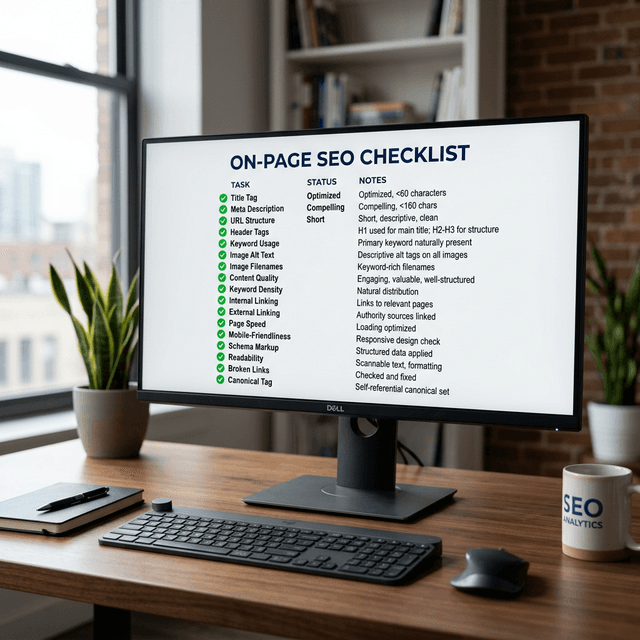
For a comprehensive technical audit checklist that covers all the elements relevant to affiliate sites, our how to do an SEO audit guide covers both technical and content layers, and our on-page SEO checklist addresses the page-level elements that affiliate review pages most commonly get wrong.
Building Authority for an Affiliate Site
Authority is the compounding advantage in affiliate SEO. A site with high domain authority can rank new affiliate content faster, compete for higher-difficulty commercial keywords, and hold positions under algorithm pressure better than new or low-authority sites. Building that authority requires a deliberate strategy, because affiliate sites struggle with some of the traditional link-building approaches that work well for other site types.
Editorial link building — earning links by publishing genuinely newsworthy research, data studies, or tools — works well for affiliate sites with the budget to invest in it. Original data (surveys, tests, benchmark reports) attracts links from journalists, bloggers, and industry publications. A post that includes original test results comparing the performance of ten products in a category is more linkable than a standard review, because journalists and other content creators can cite your data.
Community participation in forums, subreddits, and niche communities builds brand presence and drives initial traffic to new content that hasn't yet ranked. When your affiliate content is genuinely useful, community sharing can provide the early traffic signals that help Google evaluate the page's quality and accelerate its ranking progression. For additional strategies that build site authority without relying solely on link acquisition, see our post on topical authority without backlinks.
Diversifying Beyond Google for Affiliate Revenue
The highest-performing affiliate SEOs understand that Google traffic is a distribution channel, not a business model. Over-dependence on Google for affiliate revenue creates existential vulnerability to algorithm updates — a lesson many affiliate sites learned painfully during the 2023 Helpful Content and Spam updates. Sites that had built email lists, YouTube channels, social media followings, and community presence alongside their SEO strategy survived those updates far better than sites that had invested purely in search traffic.
Email is particularly valuable for affiliate monetization because it creates a direct channel to a warm audience that you own. An email list of 10,000 people who have specifically opted in because they found your product recommendations helpful is worth dramatically more in commission revenue than 10,000 monthly organic visitors who have no other relationship with your brand. Building this list — by offering useful tools, guides, or resources in exchange for email addresses — should be a parallel priority alongside SEO for any serious affiliate business.
Build affiliate content that ranks, converts, and compounds.
Start your free AgenticSEO workflow and access AI-powered content research, keyword analysis, and competitive insights built for affiliate marketers who want sustainable SEO-driven revenue.
Ready to Automate Your SEO?
Turn this into a repeatable growth loop with prioritized opportunities, guided execution, and clear measurement windows.
Start your free AgenticSEO setup
Frequently Asked Questions
How do I prioritize this workflow each week?
Start with pages that already have impressions and are close to page-one movement potential.
How much should I change at one time?
Limit major edits so you can evaluate impact clearly and avoid masking what caused movement.
Key Takeaways
- Align updates to one clear search intent per page.
- Prioritize work by impact and implementation effort.
- Track outcomes on fixed review windows.
- Build compounding gains through consistent internal linking and content refinement.