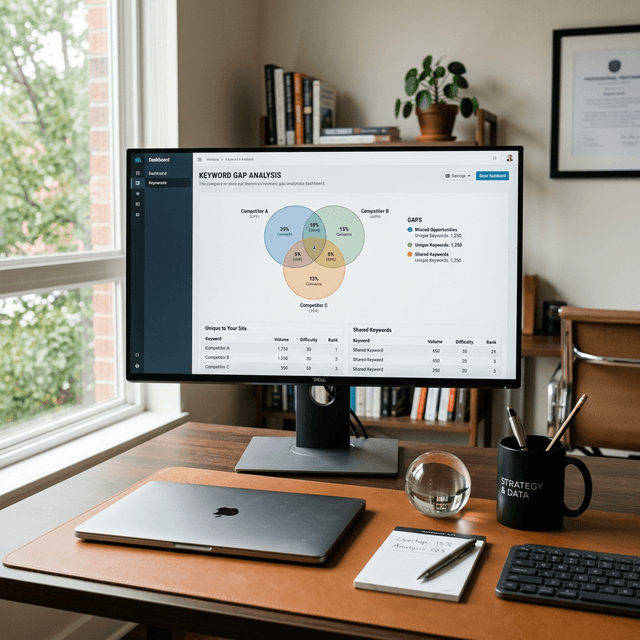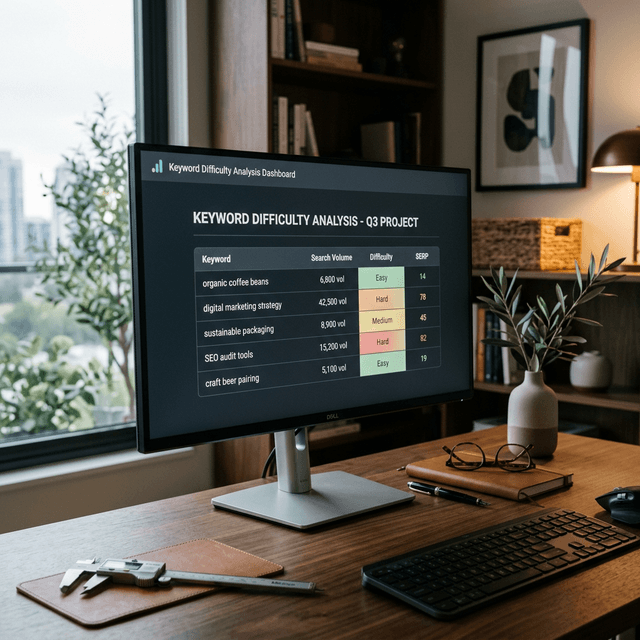

Your competitors have already done expensive work for you. They have tested topics, invested in content, built link profiles, and received Google's verdict on what works and what does not. That information is available to anyone willing to look. The question is whether you know how to extract the right insights from it.
Most competitor analysis starts and ends with "they rank for these keywords, let's target them too." That is the least valuable thing you can learn from a competitor. It tells you what they are doing but nothing about whether you can or should do the same. More useful is understanding why they rank, where they are vulnerable, and what they have overlooked.
Start with the right competitors
The first mistake in competitor analysis is analyzing the wrong competitors. Many teams default to their business competitors: the companies they lose deals to or see at industry events. But your business competitors and your SEO competitors are often different entities.
Your SEO competitors are whoever ranks for the queries your audience uses to find solutions like yours. For some queries, that might be a direct business competitor. For others, it might be a media publication, a comparison site, a Reddit thread, or a niche blog run by one person. All of these are taking traffic you could capture.
To find your real SEO competitors, start with your top 20 target queries. Search each one and note which domains appear most frequently in the top 10 results. The domains that overlap across multiple queries are your primary SEO competitors. You will typically find 5-8 domains that consistently compete for your target space.
Segment these into tiers. Tier 1 competitors have significantly more authority than you (major publications, established brands). You cannot outrank them directly for competitive terms, but you can find gaps in their coverage. Tier 2 competitors have similar or slightly higher authority. These are your direct battleground. Tier 3 competitors have less authority than you. If they rank for valuable queries, those are immediate opportunities because you already have the authority advantage.
Reverse-engineering content strategy
Once you have identified your SEO competitors, the goal is to understand their content strategy at a structural level, not to catalog every keyword they rank for.
Look at their blog or content hub and ask: what topic clusters have they built? Most content-focused sites organize around 3-7 core topic clusters, even if they do not label them explicitly. You can identify clusters by looking at internal linking patterns, URL structures, and content groupings.
For each cluster, assess depth. How many articles support each topic? How comprehensive is their pillar content? Where do they have thin coverage that creates opportunity for you? A competitor might dominate "SEO tools" with 15 articles but have only one shallow piece about "SEO for specific industries," leaving that entire angle underserved.
Publication frequency and freshness patterns reveal their investment priorities. If a competitor publishes three new articles per week in their "technical SEO" cluster but has not updated their "content strategy" cluster in six months, that neglected cluster is where their content is most vulnerable to decay. Your fresh, comprehensive content on those topics can capture rankings they are slowly losing.
Content format analysis adds another dimension. If every result for a target query is a long-form guide, publishing another long-form guide puts you in direct competition. But if you notice that no one has published a practical template, a decision framework, or an interactive tool for that query, you have a format differentiation opportunity that can outperform conventional content.
Finding gaps competitors miss
The most valuable output of competitor analysis is not a list of keywords to copy. It is a list of opportunities your competitors have created by their omissions.
Content gaps come in several forms. Topic gaps are subjects your audience cares about that no competitor covers well. These are rare for broad topics but common for specific use cases, industry applications, and emerging trends. If you serve a niche that larger competitors address generically, your specificity is a competitive advantage.
Depth gaps are more common and more immediately actionable. A competitor ranks for "how to do a content audit" with a 600-word overview. If you publish a genuinely comprehensive guide with frameworks, templates, and real examples, you can outrank them even with lower domain authority because the content quality differential is so large.
Intent gaps happen when competitors rank for a query but their content does not actually satisfy the searcher's intent. Search "SEO audit checklist" and you might find that the top results are articles about audits rather than actual checklists. Publishing a genuine, actionable checklist serves the intent better and can rank quickly.
Freshness gaps appear in any topic that evolves. SEO content from 2023 that references outdated tools, deprecated practices, or old algorithm changes is vulnerable to a 2026 version that reflects current reality. Competitors who do not refresh their content create freshness gaps that grow over time.
Turning analysis into an action plan
Competitor analysis without a structured action plan is just interesting reading. Here is how to convert insights into prioritized work.
For each gap you identify, score it the same way you would score any content opportunity: demand, achievability, relevance, and speed. A depth gap on a high-demand keyword where you already have some ranking potential scores very differently from a topic gap on a query with uncertain demand.
Group your opportunities into three categories. Quick wins are gaps where you already have a related page that can be expanded or repositioned to capture the opportunity. These should be executed within 1-2 weeks because they require modification, not creation from scratch. New content opportunities are gaps that require entirely new pages. Prioritize these by score and batch them into your content calendar. Strategic plays are larger opportunities that require multiple pieces of content, like building an entire cluster around a topic your competitors have neglected. These go on your quarterly roadmap.
The most common mistake at this stage is trying to pursue everything at once. A thorough competitor analysis might reveal 50 opportunities. You can realistically execute on 5-8 per month with quality. Pick the highest-scored opportunities and commit to them fully rather than spreading effort across 20 half-done projects.
Ongoing competitive monitoring
Competitor analysis is not a one-time project. The competitive landscape changes continuously, and the teams that track it regularly spot opportunities faster.
A monthly check is sufficient for most sites. Review whether competitors have published new content in your target clusters, whether their rankings have shifted on your shared keywords, and whether new competitors have emerged for important queries. This takes 30-45 minutes per month and prevents the scenario where a competitor quietly outflanks your best content while you are focused elsewhere.
For more on building systematic monitoring into your workflow, see SEO Automation: 7 Tasks You Should Automate First. For the broader framework these insights feed into, see The Complete AI SEO Playbook.
Ready to Automate Your SEO?
AgenticSEO monitors your competitive landscape and surfaces content gaps automatically, so analysis becomes a continuous advantage instead of a quarterly project.
Start your free AgenticSEO workflow
Related Articles
- The Complete AI SEO Playbook
- SEO Content Briefs That Rank: The 12-Point Checklist
- How to Do an SEO Audit (Without Getting Lost in 200 Tabs)
Frequently Asked Questions
What is the best first step to apply this guide?
Start with one high-potential page and one measurable hypothesis, then review results on a fixed weekly cadence.
How do I avoid over-optimizing too quickly?
Change one variable at a time where possible and track outcomes before making another major revision.
Key Takeaways
- Focus on intent alignment before adding volume.
- Prioritize updates using impact and effort, not intuition alone.
- Track outcomes in defined review windows so decisions improve over time.
- Reinforce results with internal links and clear topical structure.