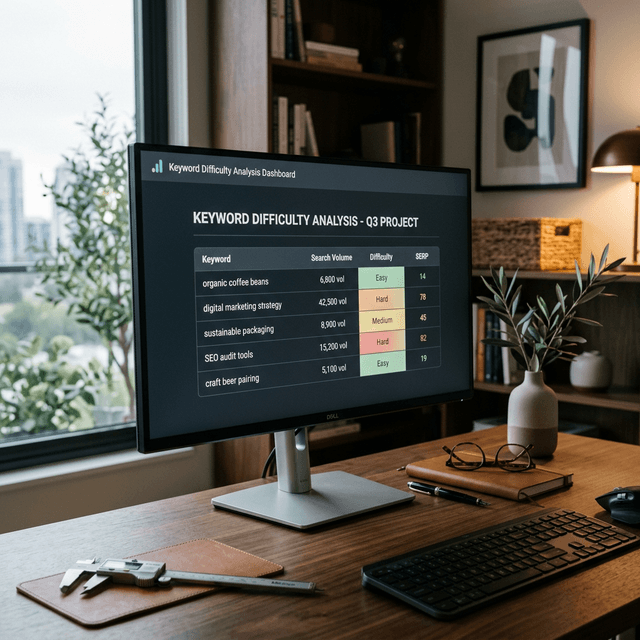

Open three different SEO tools and search the same keyword. You might see difficulty scores of 28, 54, and 71, all for the same term, all calculated at the same moment. One tool tells you this is an easy win. Another tells you it is a stretch goal. The third tells you to walk away.
They cannot all be right. And none of them is telling you what you actually need to know.
Keyword difficulty scores are useful as rough filters, but treating them as precise measurements leads to bad content strategy. Understanding what they actually measure, what they miss, and what signals to use instead is one of the most practical SEO skills you can develop.
What Keyword Difficulty Scores Actually Calculate
Every major SEO tool calculates keyword difficulty differently, but most base the score primarily on the backlink profiles of the pages currently ranking on page one.
The logic goes like this: if the pages ranking for a keyword all have hundreds of referring domains and strong domain ratings, it will likely take a similarly authoritative site to displace them. So the tool estimates how many and how strong the links are pointing to top-ranking pages, then compresses that estimate into a 0-100 scale.
This is a reasonable approximation for some queries. For many others, it is misleading.
Where Keyword Difficulty Scores Break Down
The backlink-based model misses several factors that have significant real-world impact on how hard a keyword actually is to rank for.
Content quality gaps in the SERP. A keyword might have high-authority pages ranking for it, but if those pages are thin, outdated, or poorly matched to user intent, a genuinely better piece of content can displace them even with fewer backlinks. The difficulty score does not measure content quality. It only measures link authority.
Your domain's existing topical authority. A site that has published 40 in-depth articles about personal finance has a meaningful advantage when targeting a new personal finance keyword, even against pages with more backlinks. Keyword difficulty scores are domain-agnostic; they do not factor in whether your specific site is already established as an authority in that topic area.
Search intent mismatches in the current SERP. Sometimes a keyword has strong-looking pages ranking for it, but those pages are answering a slightly different question than what searchers actually want. When there is an intent gap, the door is open for a better-matched page to rank, regardless of the difficulty score.
SERP features that reduce organic opportunity. A keyword with a difficulty score of 30 might sound easy, but if the SERP shows a featured snippet, a map pack, a People Also Ask block, and a Knowledge Panel all before the first organic result, the actual click-through opportunity for a new page is minimal. The score does not account for SERP real estate.
New content opportunity in stable SERPs. When the top-ranking pages for a keyword are 3 to 5 years old and have not been updated, Google is often receptive to fresh, current content even from a site with fewer total backlinks. The difficulty score treats a SERP full of old content the same as one with fresh pages.
Tool-by-Tool Differences in Difficulty Scoring
Here is why the same keyword shows different scores across tools:
| Tool | Primary Input for KD Score | Typical Score Behavior | |------|---------------------------|----------------------| | Ahrefs | Referring domains to top-10 ranking pages | Tends to score higher than other tools | | Moz | Page Authority of top-10 ranking pages | Moderate; PA-weighted | | SEMrush | Volume of backlinks plus other factors | Variable; often lower than Ahrefs | | Mangools | Weighted average of link strength signals | Generally lower; beginner-friendlier | | Ubersuggest | Proprietary blend | Least reliable for precise comparison |
These differences are not errors. They reflect different methodologies for measuring the same underlying concept. The problem arises when you rely on a single score without knowing which methodology your tool uses.
The practical implication: pick one tool and use its scores consistently for comparison within your own research. Do not compare a difficulty score from Ahrefs with one from Mangools and treat them as equivalent measurements.
What to Look at Instead of (or Alongside) the Score
Difficulty scores are a useful first filter but should never be the final decision factor. These signals give you a more accurate picture of actual ranking opportunity:
1. Examine the Actual SERP Pages Manually
Look at the pages currently ranking on page one. For each one, ask:
- How well does the page match the search intent?
- Is the content comprehensive, current, and useful?
- What is the domain's focus and authority in this specific topic?
When you find ranking pages that are outdated, thin, or poorly structured, the difficulty score is likely overstating the true challenge.
2. Check the Referring Domains of Ranking Pages
Rather than trusting a compressed difficulty score, pull the actual referring domain counts for the top 5 ranking pages. A keyword with an "average" difficulty might have one page with 800 referring domains and four pages with 15 to 30. The average looks difficult, but four of those five pages are beatable.
If you can produce content that competes with the 4 weaker pages and earn 20 to 40 solid backlinks, you can rank. The score would not tell you that.
3. Assess Your Topical Authority Match
Does your site already have strong coverage of related topics? If you have a well-established health blog and are targeting a health keyword with a score of 55, your topical authority may make it more achievable than a general news site targeting the same keyword with a score of 30. Context matters.
4. Look at SERP Stability
Search the keyword now, then search it again in 3 weeks. If the top 5 results are identical, the SERP is stable and entrenched. If the order has shifted or different pages are appearing, the SERP is in flux and more open to new entries. Volatile SERPs are easier to enter than stable ones, regardless of the score.
5. Evaluate the Search Volume to Competition Ratio
A keyword with 800 monthly searches and a difficulty of 25 is often a better opportunity than one with 5,000 monthly searches and a difficulty of 65. The expected traffic outcome of ranking position 3 on the lower-difficulty term may actually exceed what you could realistically achieve on the higher-volume, harder term.
A Practical Scoring Framework for Your Own Keyword Research
Instead of relying solely on tool scores, use this checklist when evaluating any keyword:
- [ ] What is the difficulty score in my primary tool?
- [ ] Are the top-ranking pages on page one genuinely strong (well-optimized, current, comprehensive)?
- [ ] Do my competitors have 50+ referring domains per page, or can I find pages with fewer?
- [ ] Does my site have established topical authority in this area?
- [ ] Is the SERP intent well-matched by current results, or is there a gap?
- [ ] What SERP features take up space before the first organic result?
- [ ] What is the ratio of search volume to competition?
A keyword that passes most of these checks is a genuine opportunity regardless of the raw score. A keyword that fails most of them is genuinely difficult regardless of what the number says.
The "Low Hanging Fruit" Trap
Chasing every keyword under a difficulty score of 20 sounds like good strategy. In practice, it often fills your content calendar with low-volume, low-relevance topics that generate traffic with no conversion potential.
Difficulty score and business relevance are completely independent dimensions. A keyword with KD 15 about a tangentially related topic is a worse choice than a keyword with KD 45 that directly addresses your buyer's core problem. The easier keyword gets ranked faster; the relevant keyword gets you customers.
The best approach is to filter first by relevance and search intent, then use difficulty as a tiebreaker between equally relevant options. Never let difficulty be the primary selection criterion.
Difficulty and Time to Rank
One thing difficulty scores do approximate reasonably well is the timeline to achieve page-one rankings. On competitive queries, even exceptional content from a strong domain can take 6 to 18 months to reach top positions. On genuinely low-difficulty terms, well-optimized new pages sometimes rank within weeks.
Use this rough calibration when building your content roadmap:
- KD 0-25: Achievable within weeks to 3 months for most sites with basic authority
- KD 26-50: Expect 3 to 9 months, depending on your domain's strength and backlink acquisition
- KD 51-70: Plan for 9 to 18 months with consistent content quality and active link building
- KD 71+: Often requires significant domain authority and years of sustained effort
These ranges are approximations. Your specific domain authority, content quality, and the actual competitiveness of the SERP (not just the score) all influence the timeline. Use these estimates for planning purposes, not as guarantees.
For a practical system to tie your keyword selection into a real content strategy, the keyword gap analysis guide shows how to find high-priority targets your competitors are winning that you are not yet pursuing.
Why Keyword Difficulty Still Has Value
Despite its limitations, the difficulty score is not worthless. It serves a legitimate function as a first-pass filter that helps you prioritize without manually analyzing every keyword in a large list.
When evaluating 500 potential keywords from a research session, sorting by difficulty first and reviewing the top and bottom segments manually is a reasonable workflow. The score removes clearly impractical options quickly.
The mistake is treating the score as the final word. Use it to identify candidates. Use manual SERP analysis to make the actual decision.
Ready to Automate Your SEO?
Enter your domain to get a free AI visibility analysis and see how AgenticSEO can help.
Key Takeaways
- Keyword difficulty scores are primarily based on the backlink profiles of top-ranking pages, which misses content quality, topical authority, and intent alignment
- The same keyword can show wildly different difficulty scores across tools because each tool uses a different methodology
- Manual SERP analysis is more reliable than the score alone: look at content quality, referring domains per page, intent match, and SERP feature density
- Business relevance should come before difficulty when selecting keywords; a relevant KD 45 keyword beats an irrelevant KD 15 every time
- Use difficulty as a planning tool for timelines, not as a binary pass/fail filter