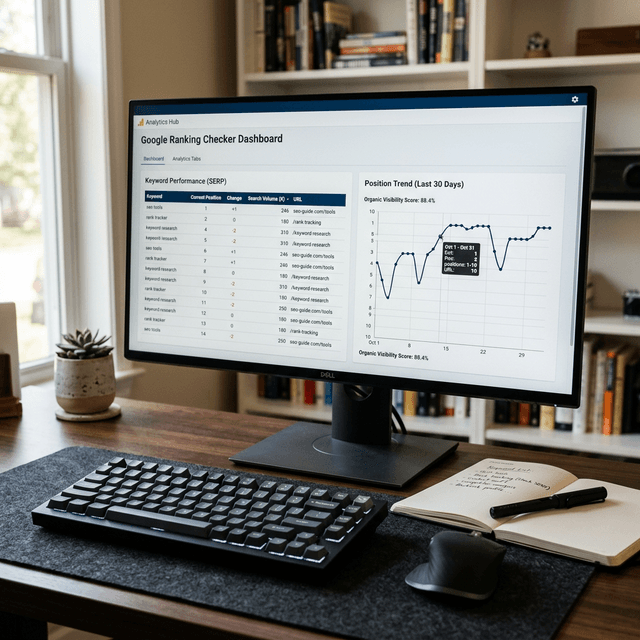

Most people think they are checking rankings. What they are really checking is noise.
Open an incognito tab, search your keyword once, see your page in position 6, and call it done. Then next day it's 11, next day it's 7, and suddenly the team is reacting to random fluctuation instead of running strategy.
If you want ranking data that helps you make better SEO decisions, avoid these nine mistakes.
For a product-led workflow, connect your own Search Console data to the AgenticSEO keyword rank checker. Exact query data is private, so it appears only after you authorize a verified property.
1) Treating one search as truth
Google results vary by location, device, and query context. One check from one browser is not a stable signal.
2) Ignoring average position logic
Search Console reports average position across impressions. It won't match your one-time spot check, and that's normal.
3) Tracking too many keywords
A 600-keyword tracker looks impressive and is operationally useless. Track your top 20-40 business-relevant terms first.
4) Watching daily volatility
Unless you're diagnosing a major update, daily checks create anxiety. Weekly windows produce signal.
5) Separating position from CTR
A page can hold position 5 and still underperform if CTR is weak. Rank and CTR must be reviewed together.
6) No page-level mapping
If you don't map each query to a target URL, you can't spot cannibalization or content mismatch.
7) Using tools without calibration
Third-party trackers can differ from Search Console. Use both, but calibrate by trend direction, not exact number.
8) Reporting rankings without actions
A report that says "up 2 positions" but triggers no next step is theater, not SEO.
9) Failing to set review triggers
Define action thresholds in advance:
- Drop 3+ spots for 2 weeks → refresh page
- Position 4-10 + low CTR → snippet rewrite
- Impressions rising + flat clicks → intent mismatch diagnosis
What a useful ranking workflow looks like
Every week:
- Pull Search Console query + page data
- Review position, impressions, CTR together
- Sort by opportunity type (push/protect/fix)
- Assign one action per opportunity
- Recheck in 14 and 28 days
This is how ranking checks become growth, not dashboard vanity.
Ready to Automate Your SEO?
Use AgenticSEO to turn ranking movements into prioritized actions automatically.
Check your ranking opportunities with AgenticSEO
Create your free AgenticSEO workspace when you are ready to connect Search Console and save the resulting action plan.
Related Articles
- How to Track Keyword Rankings Without Paying for Expensive Tools
- AI SEO Workflow: How to Go From Data to Published in One Loop
- Why SEO Traffic Plateaus (Even When You Keep Publishing)
Frequently Asked Questions
What is the best first step to apply this guide?
Start with one high-potential page and one measurable hypothesis, then review results on a fixed weekly cadence.
How do I avoid over-optimizing too quickly?
Change one variable at a time where possible and track outcomes before making another major revision.
Key Takeaways
- Focus on intent alignment before adding volume.
- Prioritize updates using impact and effort, not intuition alone.
- Track outcomes in defined review windows so decisions improve over time.
- Reinforce results with internal links and clear topical structure.