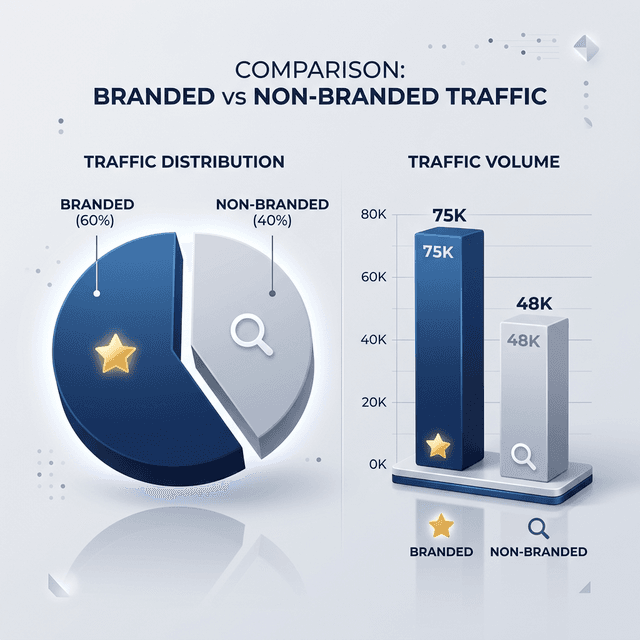

Organic traffic looks stronger when you understand where it comes from. A site getting thousands of clicks from branded searches is in a very different position from a site getting the same number of clicks from non-branded discovery.
That is why branded vs non-branded traffic matters. It helps you separate demand you already earned from visibility you are still building.
In this guide
- What branded and non-branded traffic actually mean
- How to measure both in Search Console
- Why the mix matters more than total clicks alone
- How to use each segment in reporting and planning
What Branded vs Non-Branded Traffic Means
Branded traffic comes from searches that include your brand name, product names, or common brand variations.
Examples for AgenticSEO might include:
- agenticseo
- agentic seo
- agenticseo pricing
Non-branded traffic comes from searches that describe the problem, category, or solution without specifically naming your brand.
Examples:
- seo automation software
- google search console quick wins
- content refresh strategy
If you sell another company’s products, a query with that company’s name is not branded traffic for you. That distinction matters when reporting.
Why This Split Matters
Branded and non-branded traffic answer different business questions.
Branded Traffic Shows Brand Demand
If branded clicks rise, it often means:
- more people know you
- campaigns are driving recognition
- repeat demand is increasing
- bottom-of-funnel search behavior is strengthening
Non-Branded Traffic Shows Discoverability
If non-branded clicks rise, it usually means:
- more new users are finding you
- your content is earning broader visibility
- topical coverage is improving
- SEO is expanding beyond existing brand awareness
That is why non-branded growth is often the cleaner signal of SEO expansion.
Which One Matters More?
Neither is automatically better. They do different jobs.
Branded traffic often converts better because the user already knows you. Non-branded traffic is usually more important for growth because it introduces your brand to people who were not looking for you yet.
If you only report total organic traffic, you miss that distinction. A traffic spike driven by a PR campaign or branded demand is not the same thing as broad SEO progress.
That is also why a healthy reporting setup should connect this split to broader metrics such as share of search and agentic SEO metrics.
How to Measure Branded vs Non-Branded Traffic in Search Console
Option 1: Use Search Console Insights When Available
Google’s Search Console Insights report now includes branded and non-branded traffic for eligible sites. Google notes that this classification is informational and may mislabel some queries, so treat it as directional rather than perfect.
Option 2: Use Query Filters in the Performance Report
This is still the most flexible method.
- Open Performance in Search Console.
- Filter queries that contain your brand name and major variations.
- Record clicks, impressions, CTR, and average position.
- Reverse the filter to exclude those terms for your non-branded view.
Option 3: Export and Classify in a Spreadsheet
If you need tighter control, export query data and classify terms manually or with regex rules.
This is useful when:
- your brand has common words in it
- you have multiple product names
- you want cleaner month-over-month reporting
How to Interpret the Mix Correctly
High Branded, Low Non-Branded
This often means your brand has recognition, but your broader discovery engine is weak.
High Non-Branded, Low Branded
This usually means content is attracting new users, but brand demand is still forming.
Both Growing Together
This is the strongest pattern. It usually means discoverability is feeding awareness and awareness is feeding branded demand.
What Good Reporting Looks Like
A useful branded vs non-branded report should track:
- clicks
- impressions
- CTR
- average position
- top pages by traffic type
- top queries by traffic type
- trend over time
You also want context:
- Were there campaigns running?
- Was a new feature launched?
- Did rankings improve for non-branded pages?
- Did branded demand rise after PR, ads, or product launches?
Without context, the numbers are easy to misread.
How to Improve Non-Branded Traffic
If non-branded growth is weak, focus on:
- publishing pages around problem-aware keywords
- improving content briefs that rank
- building stronger topic clusters
- refreshing pages already ranking in positions 8 to 20
- strengthening internal links to target pages
Search Console is your best source for these opportunities because it shows the terms Google already associates with your site.
For a practical workflow, use Agentic SEO and Google Search Console quick wins.
How to Improve Branded Traffic
Branded traffic usually grows from activities beyond one page-level optimization.
That includes:
- stronger brand recall
- clearer positioning
- better product and category pages
- better customer experience
- distribution, partnerships, and demand generation
SEO still supports that growth by helping branded pages rank cleanly and by turning non-branded discovery into recognizable brand familiarity.
A Simple Reporting Framework
- Measure branded clicks and impressions.
- Measure non-branded clicks and impressions.
- Compare changes against the previous period.
- Identify the top pages driving non-branded discovery.
- Identify whether branded growth came from stronger demand or just seasonality.
- Decide which content and technical actions support the weaker side of the mix.
Ready to Automate Your SEO?
AgenticSEO helps you separate branded demand from non-branded discovery, surface the pages behind both, and turn those signals into clearer SEO priorities.
Start your free AgenticSEO traffic analysis
Frequently Asked Questions
Is branded traffic good for SEO?
Yes. Strong branded traffic usually reflects healthy awareness and often converts better than non-branded traffic. The mistake is assuming branded growth alone proves your broader SEO discoverability is improving.
Should I focus more on branded or non-branded traffic?
Most growth-focused SEO programs prioritize non-branded traffic because it brings in new visitors. But you should still protect branded visibility because it captures high-intent demand.
Can Search Console separate branded and non-branded traffic automatically?
Sometimes. Search Console Insights now offers a branded and non-branded view for eligible sites, but the classification is informational and may not be perfect. Many teams still use manual query filters for tighter control.
Key Takeaways
- Branded traffic measures demand for you. Non-branded traffic measures discoverability beyond you.
- Total organic traffic without this split can hide weak SEO growth.
- Search Console filters are still one of the best ways to classify both segments.
- The strongest long-term pattern is growth in both non-branded discovery and branded demand.