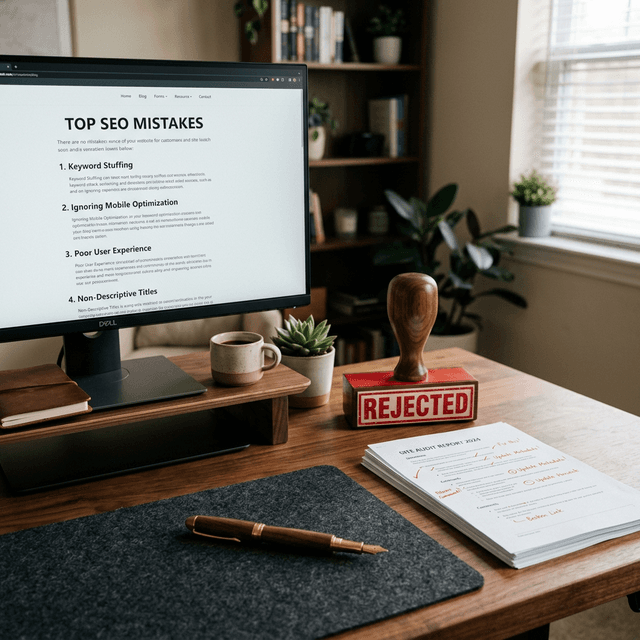

Agentic SEO can accelerate growth significantly. It can also accelerate bad decisions if the system is not built with the right guardrails.
The mistakes below come from patterns seen across teams that adopt automation-first SEO approaches. Most are avoidable once you know what to watch for.
Mistake 1: Publishing volume without intent depth
The most common failure. Teams use automation to publish faster, but each post is thin, generic, and does not genuinely answer the search query better than what already ranks.
What it looks like: 20 posts published in a month. Traffic stays flat. Rankings are mostly page 3+.
Root cause: The workflow optimizes for output speed instead of reader value. No pre-brief process. No quality gate before publishing.
How to fix it: Add a pre-brief step that defines user intent and success criteria before any writing starts. Require that every post answers a question the reader actually has, with practical depth competitors do not offer.
Mistake 2: Ignoring what already works
New content is exciting. Refreshing old content is not. But existing pages with impressions are your fastest path to more clicks.
What it looks like: A growing content library but stagnant traffic. Pages that used to perform well are slowly declining.
Root cause: No refresh queue. No system for monitoring existing page performance.
How to fix it: Reserve at least 30% of your weekly capacity for refreshes and quick wins from Search Console data. Build refresh triggers into your workflow.
Mistake 3: Weak internal linking
Publishing great content in isolation is like opening a store with no roads leading to it.
What it looks like: Individual pages rank decently but the overall cluster authority is weak. Pillar pages do not benefit from supporting content.
Root cause: Internal linking is treated as an afterthought instead of a core workflow step.
How to fix it: Make internal linking a required step in every publish and refresh action. Every new post needs at least 3 contextual links from existing content. Every cluster post links back to its pillar.
Mistake 4: No measurement discipline
If you do not track what happens after you publish or update, you are operating blind.
What it looks like: Team cannot answer basic questions like "which posts drove the most growth last month?" or "did that title change actually improve CTR?"
Root cause: No change log. No review windows. Publishing is treated as the finish line instead of the starting line.
How to fix it: Log every change with a hypothesis. Set review windows at 7, 14, 28, and 56 days. Use the data to refine your scoring model.
Mistake 5: Chasing trends without relevance
Trend-based content can drive spikes, but if the topic is not aligned with your niche, the traffic does not convert and does not build topical authority.
What it looks like: A viral post that brings 10,000 visitors who immediately bounce. No follow-up engagement. No cluster benefit.
Root cause: No relevance filter in the opportunity scoring process.
How to fix it: Add business relevance as a weighted dimension in your scoring model. Only pursue trends that connect naturally to your existing content clusters.
Mistake 6: Over-automating quality decisions
Automation is excellent for detection, scoring, and repetitive execution. It is poor at judging whether content genuinely helps a reader.
What it looks like: Content reads like it was generated without review. Factual errors. Generic advice that could apply to any site.
Root cause: No human review step in the workflow. Publishing is fully automated without a quality gate.
How to fix it: Keep humans in the approval loop for content quality, voice alignment, and factual accuracy. Automate the boring parts (data pulling, scoring, formatting). Keep the judgment parts human.
Mistake 7: Building on sand (poor technical foundation)
All the content in the world will not rank if your site has crawl issues, slow load times, or indexing problems.
What it looks like: Pages take weeks to get indexed. Core Web Vitals are poor. Sitemap is outdated or incomplete.
Root cause: Technical SEO basics were skipped in the rush to publish content.
How to fix it: Audit technical foundations before scaling content. Verify indexing, page speed, mobile usability, and sitemap accuracy. These are prerequisites, not nice-to-haves.
Mistake 8: No cluster strategy
Publishing without a cluster map leads to scattered topical coverage, accidental cannibalization, and weak authority signals.
What it looks like: Multiple pages competing for the same queries. No clear pillar-to-cluster relationships.
Root cause: Content decisions are made ad hoc without a topic architecture.
How to fix it: Build a cluster map before publishing. Define your pillar, map support posts, and assign each post a clear role. See the 30-60-90 day plan for implementation.
The meta-mistake: not learning from mistakes
The biggest risk is making the same mistakes repeatedly because there is no feedback loop.
Every mistake is useful if you capture the lesson and adjust the system. That is why weekly retros and metric tracking are not optional extras. They are the mechanism that turns mistakes into improvements.
Ready to Automate Your SEO?
Enter your domain to get a free AI visibility analysis and see how AgenticSEO can help.
Frequently Asked Questions
What is the single most damaging mistake?
Publishing without intent depth. Volume without quality wastes resources and can dilute your site authority if Google sees many low-value pages.
How do I know if I am making these mistakes?
Check your metrics. If traffic is flat despite consistent publishing, at least one of these mistakes is likely present. Start with measurement discipline and work backward.
Can these mistakes be fixed retroactively?
Yes. Most can be addressed through content refreshes, consolidation, and process improvements. The key is identifying which mistake is active and fixing the root cause, not just the symptom.
Related Articles
- What Is Agentic SEO - 14 min read
- Agentic SEO Content Refresh Strategy - 10 min read
- 30-60-90 Day Agentic SEO Plan - 10 min read
Key Takeaways
- Focus on intent alignment before adding volume.
- Prioritize updates using impact and effort, not intuition alone.
- Track outcomes in defined review windows so decisions improve over time.
- Reinforce results with internal links and clear topical structure.